Bullish and Bearish Kicker Pattern in Forex: How the Gap Signal Works and Where It Fails
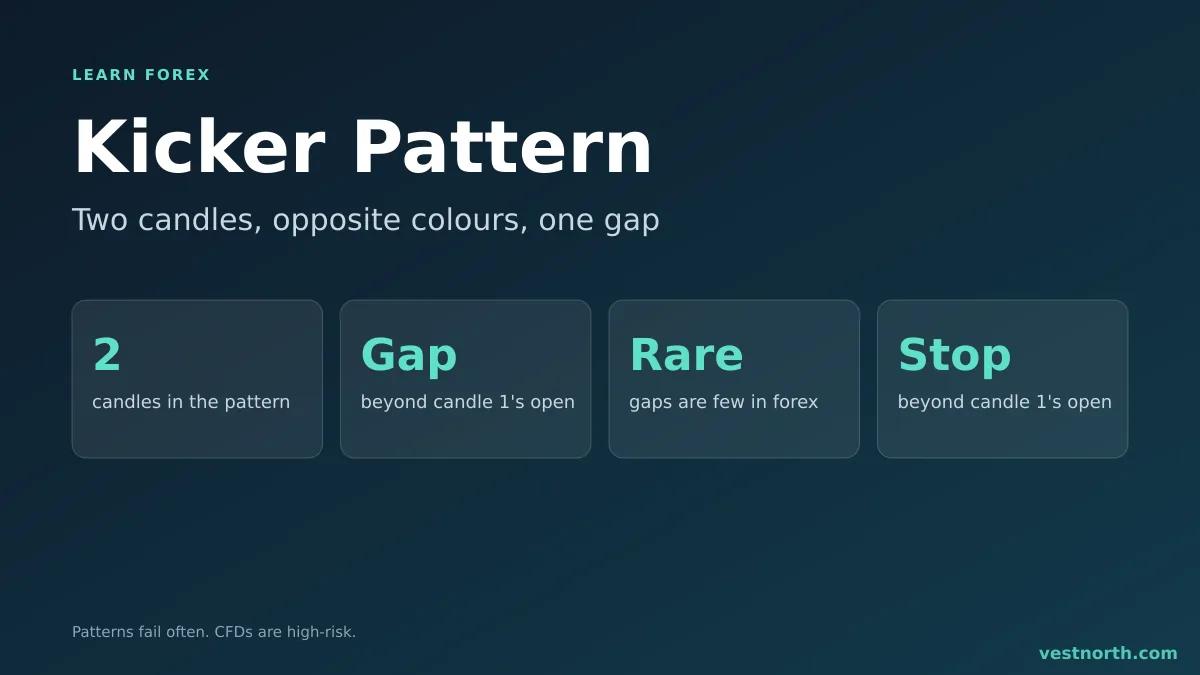
Short answer: A kicker is a two-candle reversal. The second candle has the opposite colour to the first and opens with a gap beyond the first candle’s open, so the two bodies do not overlap. A bullish kicker is a down candle followed by an up candle that opens above it. Gaps are rare in forex, so the pattern is rare too, and it still fails, so use a stop loss.
Bullish kicker (left) and bearish kicker (right). Illustration, November 2026.
What the pattern looks like
| Candle | Bullish kicker | Bearish kicker |
|---|---|---|
| 1 | Bearish candle | Bullish candle |
| 2 | Bullish candle that opens above candle 1’s open | Bearish candle that opens below candle 1’s open |
| Gap | Between candle 1’s open and candle 2’s open | Between candle 1’s open and candle 2’s open |
| Idea | Buyers took over at once | Sellers took over at once |
The key feature is the gap. In an engulfing candle the second body overlaps and covers the first. In a kicker the second body starts beyond the first candle’s open and never returns to it. Definitions vary: some books allow the second open to equal the first open, and some also require a gap past the first candle’s high. Write your own rule before you scan charts. The basics of reading candles are in candlestick basics.
Why forex kickers are rare
Stocks close every evening and often open at a new price. The spot forex market trades around the clock on weekdays, so the next candle usually opens close to where the last one closed. A gap in forex mostly shows up in two places:
- the weekend open, when the first Monday candle can start away from Friday’s close;
- fast news moves, when price jumps and few trades happen in between.
On daily charts the Monday candle is the usual candidate. Broker data feeds and platforms draw the weekend differently, so a kicker on one platform may be missing on another. Many traders also read gap-based patterns on index or stock CFDs instead, where overnight gaps are common.
Context decides
A kicker means more when it follows a clear move and appears near a level. Traders usually look for a bullish kicker:
- after a visible fall, not in the middle of sideways candles;
- near support or a level where buyers appeared before;
- when the cause of the gap is known. A gap from a news release can reverse fast, and a weekend gap may reflect a real change in sentiment.
A kicker that appears under resistance has little room. The same checks apply in reverse for the bearish version.
A worked example
These are made-up prices on EUR/USD to show the arithmetic. It is not a real trade.
- On the daily chart, Friday’s candle is bearish: it opens at 1.0900 and closes at 1.0840.
- Monday’s candle is bullish and opens at 1.0925, above Friday’s open of 1.0900, then closes at 1.0990. The gap between the two opens is 25 pips.
- Entry idea: buy near 1.0990 after Monday’s candle closes.
- Stop loss: 1.0890, 10 pips below Friday’s open. That is 100 pips from entry.
- Target idea: the next resistance at 1.1150 is 160 pips away. The reward-to-risk ratio is 1.6 to 1.
With a $1,000 account and a 1% risk rule ($10), a 100-pip stop allows 0.01 lot. On 0.01 lot a pip is worth about $0.10, so the risk is about $10. The lot size calculator shows the formula.
Waiting for the close of candle 2 gives a wide stop. An aggressive trader might enter earlier, but then the candle can still reverse before it closes, and the pattern is not complete yet.
Where the pattern fails
- Gap fills. If price falls back through candle 1’s open, the signal is cancelled. Gaps do sometimes fill within hours.
- Thin weekend prices. Spreads are wider at the open, and the first prices may not be representative. See spread widening around news.
- Platform differences. The gap may not exist in another broker’s data.
- Wide stop. Putting the stop beyond the first candle’s open can leave a large distance, as above.
- No trend to reverse. A gap in a flat market is just a gap.
- Few samples. Rare patterns give you few cases to learn from.
How to use it in a plan
- Write the rule: gap size in pips, and whether the second open may equal the first open.
- Check the chart you use. If gaps appear only at the weekend, the pattern will be rare there.
- Decide the entry before the trade, for example a market order after candle 2 closes.
- Set the stop beyond candle 1’s open and size the trade from the stop distance; see position sizing.
- Skip the trade if the ratio to the next level is poor. What is a stop loss covers the exit.
- Record the result in your journal.
Bottom line
A kicker is a sharp two-candle reversal signal that depends on a gap, and gaps are uncommon in forex. When one appears, check its cause, the nearby levels and the distance to the stop before anything else. The signal can fail as soon as price fills the gap. Size the trade from the stop and only risk money you can afford to lose. CFDs are complex, high-risk instruments.
Frequently asked questions
What is a kicker pattern?
A kicker is a two-candle reversal. The second candle has the opposite colour to the first and opens with a gap beyond the first candle's open, then keeps going in the new direction.
What is a bullish kicker?
A bearish candle is followed by a bullish candle that opens above the first candle's open. The gap shows buyers took over immediately, with no overlap between the two bodies.
What is a bearish kicker?
A bullish candle is followed by a bearish candle that opens below the first candle's open. The two bodies do not overlap.
Do kickers appear often in forex?
Rarely. The forex market trades around the clock on weekdays, so gaps mostly show up at the weekend open or after a sudden news move. On a short chart the pattern may not appear for weeks.
How is a kicker different from an engulfing candle?
An engulfing candle overlaps the previous body and covers it. A kicker leaves a gap and the bodies do not overlap, which makes it a sharper but rarer signal.
Where should the stop loss go?
Many traders place it just beyond the first candle's open, because a close back inside that candle cancels the idea. Others use the low of the second candle. Define it before the trade.