Martingale in Forex: Why Doubling After Every Loss Has a Hidden Ceiling
Short answer: A martingale doubles the lot size after every losing trade, so that the first win recovers all earlier losses plus one original unit. With a 0.01 lot start and a 20-pip stop, that unit is $2. After seven losses in a row the account is down $254, and the eighth trade would risk another $256. The win is always small and the loss keeps growing, which is why the method runs into margin limits, lot limits or an empty account.
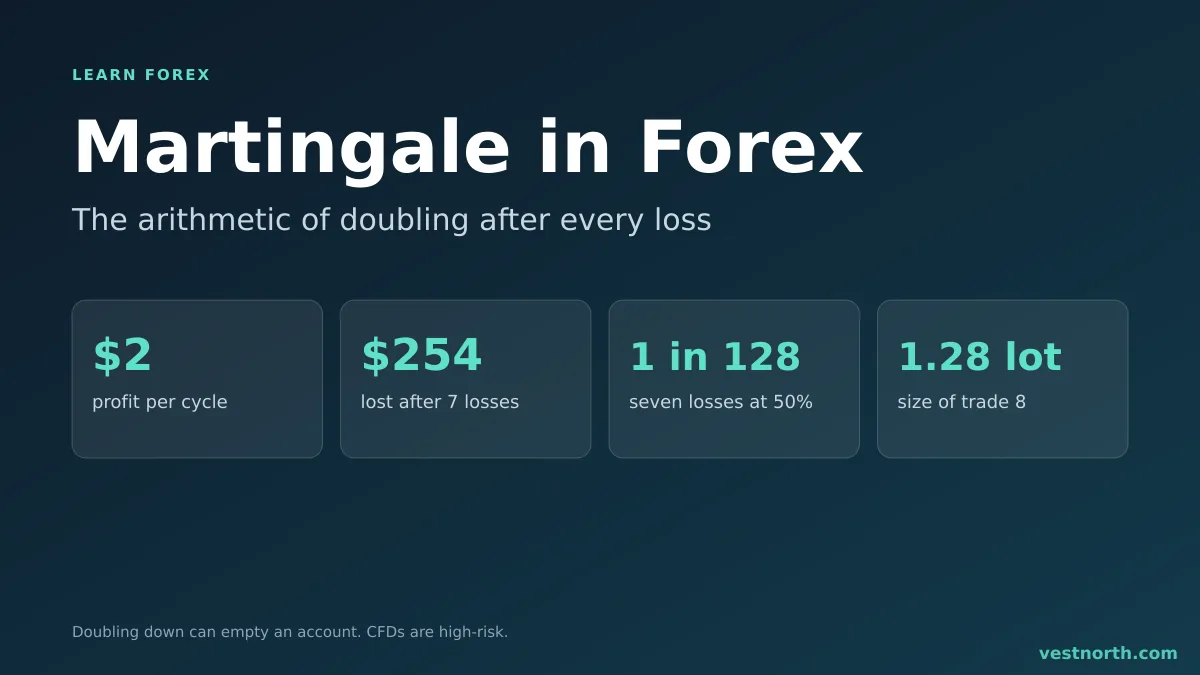
Doubling lot sizes after each loss. Illustration with made-up trades, November 2026.
How a martingale works
The idea comes from betting on a coin flip: double the stake after each loss, and the first win pays back everything. In forex the same rule is applied to lot size. The trade has a fixed stop and a fixed target of the same distance, so a win earns what the current trade could have lost.
Some automated systems and “grid” tools use the same rule, with the doubling hidden inside the settings. The arithmetic does not change.
The arithmetic, step by step
These are made-up trades on EUR/USD. Each trade has a 20-pip stop and a 20-pip target. A pip is worth about $10 per standard lot, so a 20-pip loss costs $200 per lot, or $2 per 0.01 lot.
| Trade | Lot size | Loss if stopped | Total lost so far |
|---|---|---|---|
| 1 | 0.01 | $2 | $2 |
| 2 | 0.02 | $4 | $6 |
| 3 | 0.04 | $8 | $14 |
| 4 | 0.08 | $16 | $30 |
| 5 | 0.16 | $32 | $62 |
| 6 | 0.32 | $64 | $126 |
| 7 | 0.64 | $128 | $254 |
| 8 | 1.28 | $256 | $510 |
If trade 4 wins, it earns $16 and the earlier losses total $14, so the cycle ends $2 ahead. If trade 7 wins, it earns $128 against $126 of losses, and the cycle ends $2 ahead again. The profit never grows, while the amount at risk doubles each time.
To make $2, the trader had to be willing to lose $254 and then take a trade that can lose $256.
How likely is a long streak?
Assume a 50% win rate, which ignores the spread and is generous. The chance of losing seven trades in a row is 0.5 to the power of 7, which is 1 in 128, or about 0.78%. That sounds rare. Run 200 separate cycles and the chance that at least one of them hits seven losses is 1 - (127/128) to the power of 200, about 79%.
A win rate of 50% is also not guaranteed. Markets trend, and a stop 20 pips away can be hit many times in a row during one strong move. Losses in a trend are not independent coin flips, which makes streaks more likely than the simple odds suggest.
The limits that end the run
- Account size. A $1,000 account that can lose $254 will still be at $746 and facing a trade that risks $256. Most beginners do not have a plan for that point.
- Margin. A 1.28 lot position needs far more margin than a 0.01 lot one. When free margin runs short, the next order is refused or the account faces a margin call and stop out before the doubling can finish.
- Maximum lot size. Brokers set a maximum size per order. Check the limit in your account terms. When the next doubled order is above it, the cycle cannot continue.
- Spread and slippage. Every trade pays the spread, and a fast market can fill a stop beyond the stop price. A doubled trade makes both costs bigger.
- Psychology. Placing the eighth trade at $256 of risk after $254 of losses is hard to do on schedule. See trading psychology.
Why the math does not rescue it
Expected value per trade is the win rate times the average win minus the loss rate times the average loss. A martingale changes the order of wins and losses, not the expectancy of each trade. If a single trade has zero or negative expectancy, a doubling rule cannot make it positive. It trades many small wins for a small chance of a very large loss, and the equity curve looks smooth until the large loss arrives.
The drawdown in that large loss is also the figure that matters for the account. Seven losses on a $1,000 account is a 25.4% drawdown, and the cycle’s profit target is 0.2%.
Safer ways to change size
- Fixed fractional risk. Risk the same percentage on every trade, as in risk per trade. A losing streak then shrinks the lot size automatically, since the account is smaller.
- Anti-martingale. Add size only after wins, with a rising stop, as in scaling in and pyramiding.
- Hard cap. If you still test a doubling rule, fix the maximum number of steps and the maximum loss in advance, and stop the cycle when it is reached. Test it on a demo account first.
- Use stops. A stop loss on every trade defines the loss. A martingale without a stop and with doubling has no limit at all except the account.
Size every trade from the stop distance using position sizing.
Bottom line
A martingale gives a high chance of a small gain per cycle and a small chance of a very large loss. The table shows $254 of losses after seven trades in a row, against a $2 target. Margin, the maximum lot and the size of the account set a ceiling that the doubling will reach, usually during the market move you least want to be caught in. Fixed-percentage risk and a stop on every trade are simpler and have no hidden cliff. CFDs are complex, high-risk instruments, so only trade money you can afford to lose.
Frequently asked questions
What is a martingale strategy in forex?
A martingale strategy doubles the position size after each losing trade, so that the first winner recovers all earlier losses and adds one original unit of profit. It comes from a betting system.
Does martingale work in forex?
It can produce a long run of small wins. The problem is that one long losing streak, or a hit to the margin limit, can erase all of them. The profit per cycle stays one unit while the possible loss grows each step.
How much money do you need for a martingale?
More than most beginners expect. With a 0.01 lot start and a 20-pip stop, seven losses in a row cost $254 and the eighth trade would risk $256 more, before margin for the larger lots is counted.
How likely is a losing streak?
At a 50% win rate, seven losses in a row happen about once in 128 series (0.78%). Across 200 independent series the chance of at least one such streak is about 79%.
Is martingale the same as averaging down?
They are close relatives. Both add size to a losing position, but a martingale follows a fixed doubling rule, and averaging down adds at chosen prices. Both increase risk while the original idea is failing.
What is the opposite of a martingale?
Anti-martingale methods add size after wins and cut size after losses. Pyramiding into a winning trade with a rising stop is one example.