What Is a Pip in Forex? Meaning, Size and How to Count
Short answer: A pip is the standard unit of price movement in forex: 0.0001 on most pairs and 0.01 on yen pairs. If EUR/USD goes from 1.0850 to 1.0890, it moved 40 pips. What a pip is worth in money depends on your trade size and account currency, which our pip value guide covers.
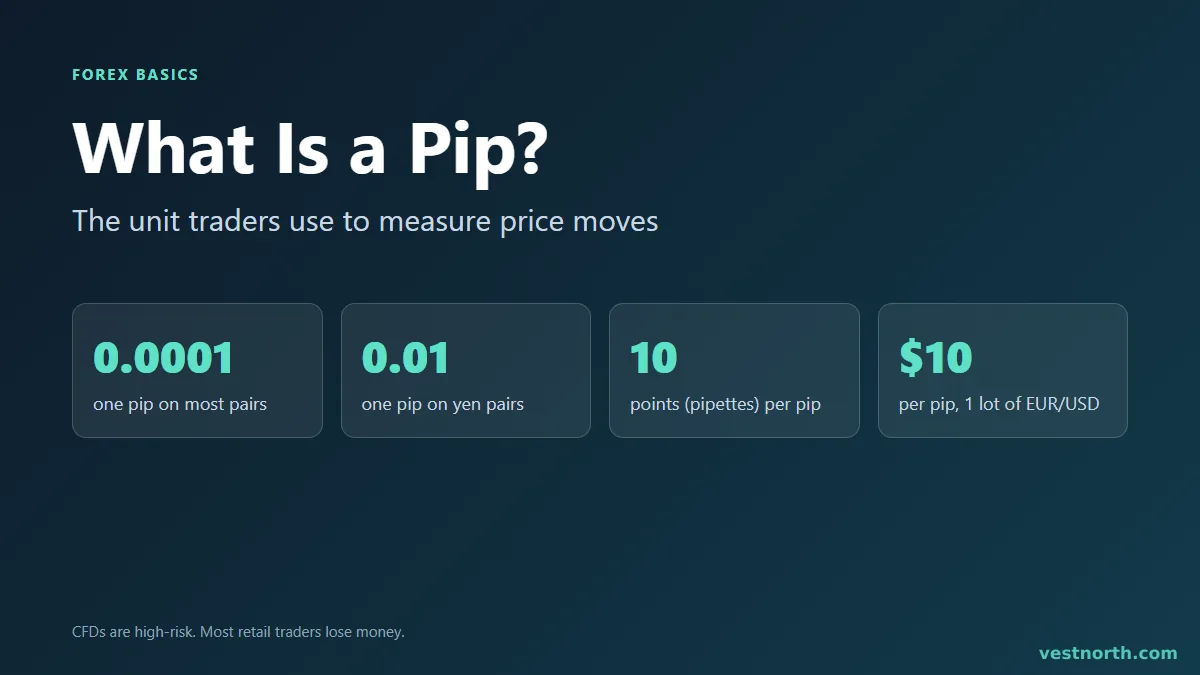
A pip in four numbers. Illustration, October 2026.
Pip size by instrument
| Instrument | Pip size | 1 pip on a quote | Notes |
|---|---|---|---|
| Most pairs (EUR/USD, GBP/USD, AUD/USD, USD/CAD, EUR/GBP) | 0.0001 | 1.0850 → 1.0851 | Fourth decimal place |
| Yen pairs (USD/JPY, EUR/JPY, GBP/JPY) | 0.01 | 150.25 → 150.26 | Second decimal place |
| Gold (XAU/USD), common convention | 0.1 | 2,400.0 → 2,400.1 | Some platforms use 0.01 |
| Index CFDs (US30, US500, NAS100) | No pips | 1 index point | Value per point set by the broker |
The rule for currencies is short: the pip is the fourth decimal place, except on yen pairs, where it is the second. One yen is worth far less than one dollar or euro, so yen prices carry fewer decimals.
Gold and other CFDs have no universal standard. Many platforms treat 0.1 as a gold pip and some use 0.01. That is a tenfold difference in every stop loss you set, so open the contract specification on your platform before you trade gold.
How to read a pip on a live quote
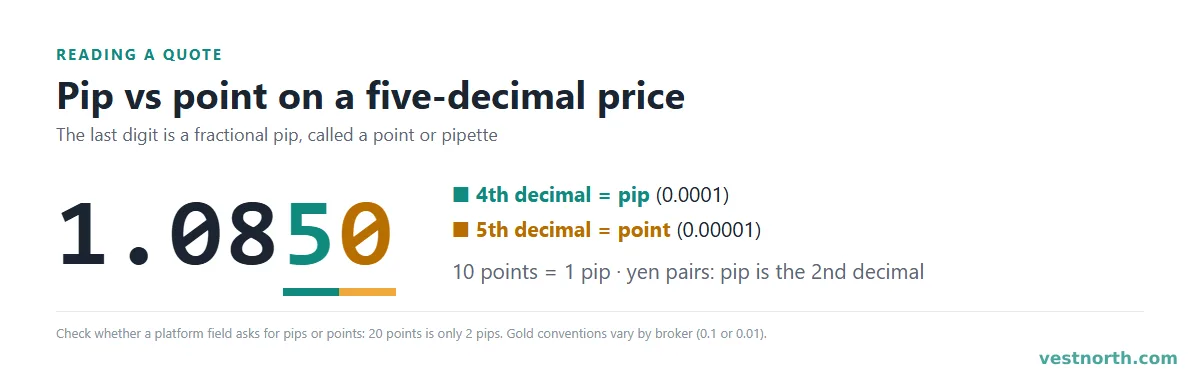
Most brokers quote one decimal more than the pip. Take a EUR/USD price of 1.08537:
- 1.08: the “big figure”, the part that rarely changes during a day.
- 3: the pip digit (the fourth decimal).
- 7: the fractional pip, also called a pipette.
So 1.08537 reads as “1.0853 and seven tenths of a pip”. On USD/JPY the same idea applies two places earlier: in 150.257, the 5 is the pip digit and the 7 is the pipette.
Many platforms print the pip digits larger than the rest of the price for this reason. If the price moves from 1.08537 to 1.08612, that is 0.00075, or 7.5 pips.
Pip, pipette, point and tick
These four words get mixed up, and the confusion causes real errors in order tickets.
| Term | What it means | EUR/USD | USD/JPY |
|---|---|---|---|
| Pip | Standard unit of movement | 0.0001 | 0.01 |
| Pipette (fractional pip) | One tenth of a pip | 0.00001 | 0.001 |
| Point (MetaTrader) | Smallest price step the symbol shows | 0.00001 | 0.001 |
| Tick | One change in the price, of any size | varies | varies |
On a five-decimal quote, 1 pip = 10 points. If a MetaTrader field asks for a distance in points and you type 20 thinking in pips, your stop sits 2 pips away and will likely be hit by normal price noise.
“Point” has a second meaning on indices. Traders say the US500 “fell 30 points” when the index dropped 30.0, while MetaTrader’s point for that symbol may be 0.1 or 0.01. Read the field label and the contract specification, and never assume the two meanings match.
How to count pips
Subtract the lower price from the higher one, then divide by the pip size.
| Move | Difference | ÷ pip size | Pips |
|---|---|---|---|
| EUR/USD 1.0850 → 1.0912 | 0.0062 | ÷ 0.0001 | 62 |
| GBP/USD 1.2745 → 1.2698 (down) | 0.0047 | ÷ 0.0001 | 47 |
| USD/JPY 149.80 → 150.35 | 0.55 | ÷ 0.01 | 55 |
| EUR/USD 1.08537 → 1.08612 | 0.00075 | ÷ 0.0001 | 7.5 |
| Gold 2,400.0 → 2,412.5 (0.1 pip) | 12.5 | ÷ 0.1 | 125 |
A quick check for yen pairs: a move of 1.00 yen (150.00 to 151.00) is 100 pips. On gold with a 0.1 pip, a $1 move in the price is 10 pips.
What is a pip worth in money?
A pip is a distance, not an amount. It turns into money only once you pick a trade size. One case worth remembering: on EUR/USD with a US dollar account, 1 pip is $10 on 1 lot, $1 on 0.1 lot and $0.10 on 0.01 lot. On USD/JPY at 150.00 it is about $6.67 per lot, and on gold it depends on how your platform defines a gold pip.
The formula, the pair-by-pair table, euro and pound accounts, and the link between pip value and your stop loss are in the pip value guide. For a live number, use the pip calculator.
One 30-pip move, three instruments, three lot sizes
The same pip count is a very different price move and a very different amount of money depending on the instrument. All figures assume a US dollar account and are arithmetic, not forecasts.
| Instrument | 30 pips equals | Pip value per 1 lot | 30 pips at 1 lot | at 0.1 lot | at 0.01 lot |
|---|---|---|---|---|---|
| EUR/USD | 0.0030 | $10.00 | $300.00 | $30.00 | $3.00 |
| USD/JPY at 150.00 | 0.30 yen | about $6.67 | about $200.00 | about $20.00 | about $2.00 |
| Gold, 0.1 pip, 100 oz lot | $3.00 | $10.00 | $300.00 | $30.00 | $3.00 |
| Gold, 0.01 pip, 100 oz lot | $0.30 | $1.00 | $30.00 | $3.00 | $0.30 |
How the USD/JPY row is built: 1 lot is 100,000 units, so one pip of 0.01 yen is 100,000 × 0.01 = 1,000 yen. Converted at 150.00 yen per dollar, that is 1,000 ÷ 150 = $6.67. Thirty pips is 30 × $6.67 = $200.
How the gold rows are built: 1 lot of gold is commonly 100 troy ounces (check your contract). A 0.1 pip on 100 ounces is $10, and a 0.01 pip is $1. The two gold rows describe the same lot with two definitions of a pip, so a “30-pip” stop is a $3.00 move on one platform and a $0.30 move on the other. For gold-specific cases, see the gold pip calculator.
Why the USD/JPY pip value changes
On EUR/USD the pip value stays at $10 per lot because the quote currency is the dollar. On USD/JPY the pip is paid in yen, so its dollar value moves with the exchange rate. The same 1,000-yen pip is worth less in dollars as the dollar buys more yen.
| USD/JPY rate | Pip value per 1 lot | Per 0.1 lot | 30 pips at 1 lot |
|---|---|---|---|
| 140.00 | $7.14 | $0.71 | $214.29 |
| 150.00 | $6.67 | $0.67 | $200.00 |
| 160.00 | $6.25 | $0.63 | $187.50 |
A stop sized in dollars at 140 therefore risks a little less than planned at 160 if you keep the same lot size and pip distance, and the reverse when the rate falls. The change is small day to day, but a platform that shows pip value live (or the pip calculator) saves you from using a stale figure.
From pips to lot size: a worked example
Pips become useful when the stop distance and the money at risk are both known. Say a trade on EUR/USD has a stop 25 pips away and the plan allows $50 of loss on that trade.
- Pip value per 1 lot: $10.
- Loss at 1 lot if the stop is hit: 25 × $10 = $250.
- Lot size: $50 ÷ $250 = 0.2 lot.
Check it the other way: 0.2 lot is $2 per pip, and 25 pips × $2 = $50. The spread and slippage come on top, so the real loss on a stop can be somewhat larger. The same steps on USD/JPY at 150.00 give $50 ÷ (25 × $6.67) = 0.30 lot. The lot size calculator does this arithmetic for any pair, and position sizing explains where the $50 figure comes from.
Turning a pip distance into a price level
Orders are placed at prices, so a stop given in pips has to be converted. Add the distance for a stop above the entry (a sell) and subtract it for a stop below the entry (a buy).
| Trade | Entry | Stop distance | Pip size | Stop price |
|---|---|---|---|---|
| Buy EUR/USD | 1.0850 | 25 pips | 0.0001 | 1.0850 − 0.0025 = 1.0825 |
| Sell USD/JPY | 150.40 | 40 pips | 0.01 | 150.40 + 0.40 = 150.80 |
| Buy gold, 0.1 pip | 2,400.0 | 80 pips | 0.1 | 2,400.0 − 8.0 = 2,392.0 |
| Buy gold, 0.01 pip | 2,400.0 | 80 pips | 0.01 | 2,400.0 − 0.8 = 2,399.2 |
The last two rows start from the same entry and the same “80 pips”, yet the stops are $8.00 and $0.80 away. Gold is the instrument where the pip definition decides whether the stop is sensible or sits inside normal noise.
Pip value if your account is not in US dollars
The $10 per lot figure holds for EUR/USD only in a dollar account. In another currency the dollar pip value is converted at the current rate.
| Account currency | Conversion | 1 pip on 1 lot of EUR/USD |
|---|---|---|
| USD | none | $10.00 |
| EUR | $10 ÷ 1.0850 (EUR/USD) | about €9.22 |
| GBP | $10 ÷ 1.2700 (GBP/USD) | about £7.87 |
The rates are examples. Your platform converts at the live rate, so the figure moves a little every day. The pip count stays the same.
Five checks before you send an order
- Is the field in pips, points or price? Ten points is one pip on a five-decimal quote.
- Is the pair a yen pair? The pip is the second decimal.
- On gold or an index, what does the contract specification call a pip or point?
- What is one pip worth at this lot size and in your account currency?
- Does the spread, in pips, already use up a large part of the target?
Pips in a trade plan: a quick example
You buy EUR/USD at 1.0850, with a stop loss at 1.0820 and a target at 1.0910. Count the distances first: the stop is 30 pips away and the target 60 pips. Those two figures stay the same whether you trade 0.01 lot or 1 lot. Only the money attached to each pip changes. Planning in pips first, then choosing the size, is why traders quote exits in pips.
A yen pair works the same way, with two decimals. You sell USD/JPY at 150.40 and the price falls to 149.90: that is 0.50 ÷ 0.01 = 50 pips in your favour. Gold is the odd one out, because a “gold pip” is a platform convention (see the table above). A $12.50 move in gold is 125 pips at 0.1 and 1,250 pips at 0.01.
All figures are arithmetic illustrations, not forecasts, and losses are counted exactly the same way.
Worked example: what the spread costs in pips
The spread is the first pip distance you meet. You see EUR/USD quoted at 1.08500 bid and 1.08512 ask. The gap is 0.00012, which is 1.2 pips. Buying at the ask means the trade starts 1.2 pips below break-even.
| Trade size | Spread cost (1.2 pips) | Pips needed to break even |
|---|---|---|
| 1 lot | $12 | 1.2 |
| 0.1 lot | $1.20 | 1.2 |
| 0.01 lot | $0.12 | 1.2 |
The pip count does not change with size, only the dollar cost does. On a 20-pip target that spread takes 6% of the move. On a 5-pip scalping target it takes 24%, which is why the spread matters more the smaller your target is. See what a spread is and spread vs commission.
Practice: count these five moves
Try them before reading the answers. Each one uses the rules above and nothing else.
- GBP/USD moves from 1.2610 to 1.2588.
- EUR/JPY moves from 162.40 to 163.15.
- AUD/USD moves from 0.66512 to 0.66587 on a five-decimal quote.
- Gold moves from 2,385.0 to 2,379.4 on a platform that uses a 0.1 gold pip.
- A MetaTrader stop loss field on EUR/USD shows 150 points.
Answers:
| # | Working | Result |
|---|---|---|
| 1 | 1.2610 − 1.2588 = 0.0022, ÷ 0.0001 | 22 pips down |
| 2 | 163.15 − 162.40 = 0.75, ÷ 0.01 | 75 pips up |
| 3 | 0.66587 − 0.66512 = 0.00075, ÷ 0.0001 | 7.5 pips up |
| 4 | 2,385.0 − 2,379.4 = 5.6, ÷ 0.1 | 56 pips down |
| 5 | 150 points ÷ 10 points per pip | 15 pips |
If you got number 2 or number 5 wrong, the yen rule and the pip-versus-point rule are the two to practise. They cause most sizing errors on real order tickets. To turn any of these distances into dollars, put the pip count and your lot size into the lot size calculator.
How big is one pip relative to the price?
A pip is a fixed step, but its share of the price differs by pair. On EUR/USD at 1.0850, one pip (0.0001) is about 0.009% of the price. On USD/JPY at 150.00, one pip (0.01) is about 0.007%. On gold at 2,400.0 with a 0.1 pip, it is about 0.004%. Pips are comparable as steps, not as percentage moves, so a 50-pip move on one instrument is not the same relative move as 50 pips on another. Percentage change, or the average true range, is a fairer way to compare volatility across instruments.
Common mistakes with pips
- Typing pips into a points field. A 20-point stop on a five-decimal quote is 2 pips.
- Counting yen pairs with four decimals. 150.25 to 150.75 is 50 pips, not 5,000.
- Assuming $10 per pip on every pair. That holds only when the quote currency is the dollar and your account is in dollars.
- Using another broker’s gold convention. 0.1 or 0.01 per pip changes the dollar risk tenfold.
- Reading 0.01 lot as $0.01. It is 1,000 units of the base currency, worth about $1,085 on EUR/USD at 1.0850.
- Counting a stop from the wrong price. A buy order exits at the bid, so measure the stop distance from the ask you paid and add the spread.
- Forgetting the spread. A trade opens already down by the spread, so a 1.2-pip spread on 1 lot of EUR/USD is $12 before the price moves.
Bottom line
A pip is 0.0001 on most pairs, 0.01 on yen pairs, and whatever your platform defines on gold. Count pips first, then turn them into money with your lot size. Check whether a field asks for pips or points before you place an order. Only risk money you can afford to lose, because leveraged CFDs can lose value quickly.
Frequently asked questions
What is a pip in simple terms?
A pip is the standard unit for measuring how much a currency price has moved. On most pairs it is the fourth decimal place (0.0001); on yen pairs it is the second decimal place (0.01).
1 pip is equal to how many dollars?
On EUR/USD with a US dollar account, 1 pip is $10 on 1 lot, $1 on 0.1 lot and $0.10 on 0.01 lot. Other pairs and account currencies change the figure; the pip value guide shows how to calculate it.
What is the difference between a pip and a pipette?
A pipette is one tenth of a pip, the extra fifth decimal (or third decimal on yen pairs) that most brokers now quote. MetaTrader calls it a point. 10 pipettes or points make 1 pip.
How many pips is 1.0850 to 1.0900?
50 pips. Subtract the prices (0.0050) and divide by the pip size (0.0001).
How many pips is a $1 move on gold?
It depends on how your platform defines a gold pip. With a pip of 0.1, a $1 move in the gold price is 10 pips; if your platform counts 0.01 as a pip, it is 100 pips.
How much is 1 pip on USD/JPY?
At a rate of 150.00, 1 pip on 1 lot is about $6.67, because the pip is 1,000 yen and is converted to dollars. The dollar value drifts as the USD/JPY rate moves, so use a live figure.
How many dollars is 30 pips on gold?
On 1 lot of 100 ounces, 30 pips is $300 if your platform counts 0.1 as a pip and $30 if it counts 0.01. The price itself moves $3.00 or $0.30. Check the pip definition first.
What does 'pip' stand for?
It is commonly expanded as 'percentage in point' or 'price interest point'. Both are backronyms; in practice it simply means the standard price increment.